
X
Most workplace productivity investments come with a catch: someone has to change. New software needs an adoption curve. New processes need training and enforcement. New collaboration tools need people to actually open them. The return only arrives if behavior shifts, and behavior is the hardest thing in any organization to move.
Acoustics work differently. The surfaces are already there: the ceiling spanning the entire floor, the walls of every conference room. Treating them converts space you already own—and already pay for—into measurable performance, and it does so without a single meeting, memo, or training session. From the day the installation is finished, every person in the room gets the benefit whether they know why or not.
That benefit is substantial. Research links the sound environment directly to work performance. When attention holds without repeated interruption, focused work finishes faster and people end the day with more left in the tank. Roles built on sustained concentration, such as engineering, programming, accounting, and technical writing (to name a few) capture the most, and the gain repeats every workday for the life of the building.
Open floor plans make the opportunity larger, not smaller. The layout already delivers collaboration and flexibility; acoustic treatment adds the focus that the layout alone can’t provide. The result is an open room that still functions as a place to think, with no square footage sacrificed and no walls rebuilt.

Speech privacy comes along with it at no additional effort. A well-tuned office lets a team talk openly at their desks, take a client call with confidence, and handle sensitive matters without lowering their voices. Discretion stops being something employees have to manage and becomes a property of the room itself.
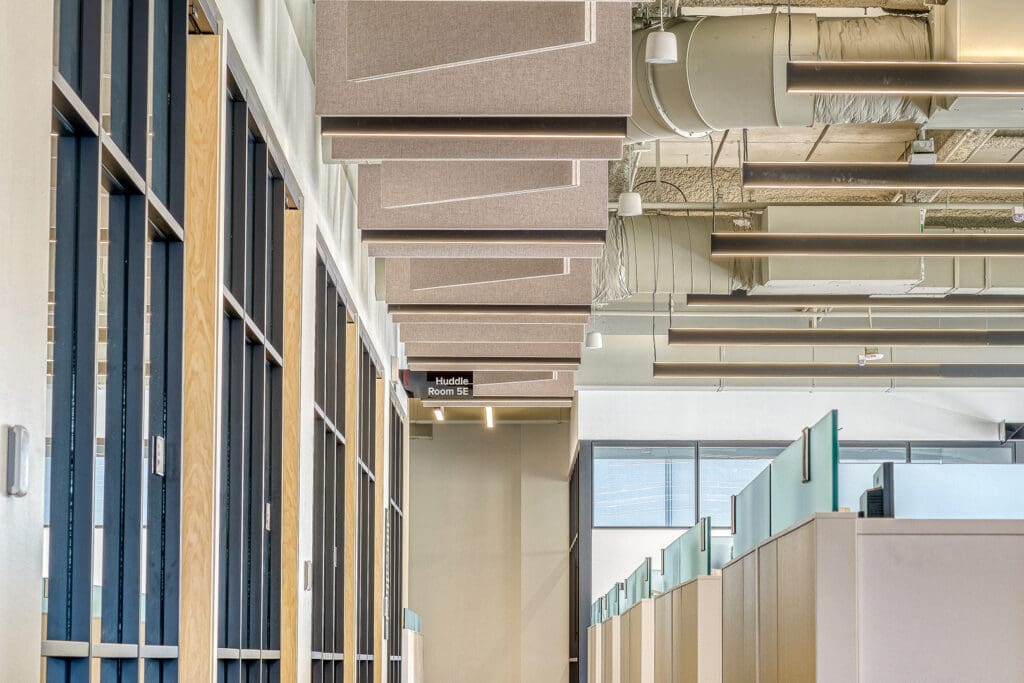
The ceiling is the largest untapped asset in the building. It spans the entire workspace with few interruptions, which means treating it delivers results across the whole floor in one project. Acoustic clouds, suspended baffles, and custom-designed diffusers intercept overhead reflections at the source, lowering sound levels while sharpening speech clarity exactly where communication is intended.

Wall treatments extend the same return into conference rooms, private offices, and collaboration spaces. The strongest outcomes originate from designing for the room as a whole: mapping how sound actually moves through the space, then treating the surfaces that return the most performance per square foot.
For organizations that want the acoustic return and a design upgrade in the same decision, custom-made acoustic diffusers do both. Rather than simply absorbing sound, diffusers scatter it in multiple directions, softening harsh reflections while keeping the room’s natural liveliness intact. Available in custom sizes, materials, and geometric designs, they become architectural features in their own right — one project, two returns.
This is a capital improvement that behaves like a permanent one. It doesn’t depreciate into irrelevance the way a photocopier does, it doesn’t need renewal like a software license, and it doesn’t require anyone to remember to use it. Teams communicate more clearly, stay focused longer, and finish the day less fatigued. Visitors notice immediately, forming an impression of a workspace that feels calm, professional, and deliberately-built.
Beginning the acoustic transformation is the one place where waiting has a real cost. Acoustic work is dramatically less expensive when it rides along with something already happening, such as a buildout, a floor reconfiguration, a lease renewal, or a ceiling grid coming down for mechanical work. Ceilings are open, crews are mobilized, and the design can be integrated rather than retrofitted around finished surfaces. If any of that is on your calendar in the next year, the specification should be written now, while it costs a conversation instead of a second mobilization. And if nothing is scheduled, the return doesn’t wait for a project to justify itself, it simply starts the day the work is done.
A great office supports the people who use it every day. Planning acoustics alongside lighting, furniture, and technology turns the building itself into a contributor. Collaboration and concentration reinforce each other, with nothing asked of the people in between.
To learn how your office can benefit from acoustic treatments, call Oeler Industries, Inc. at 412-884-3000 or click here.